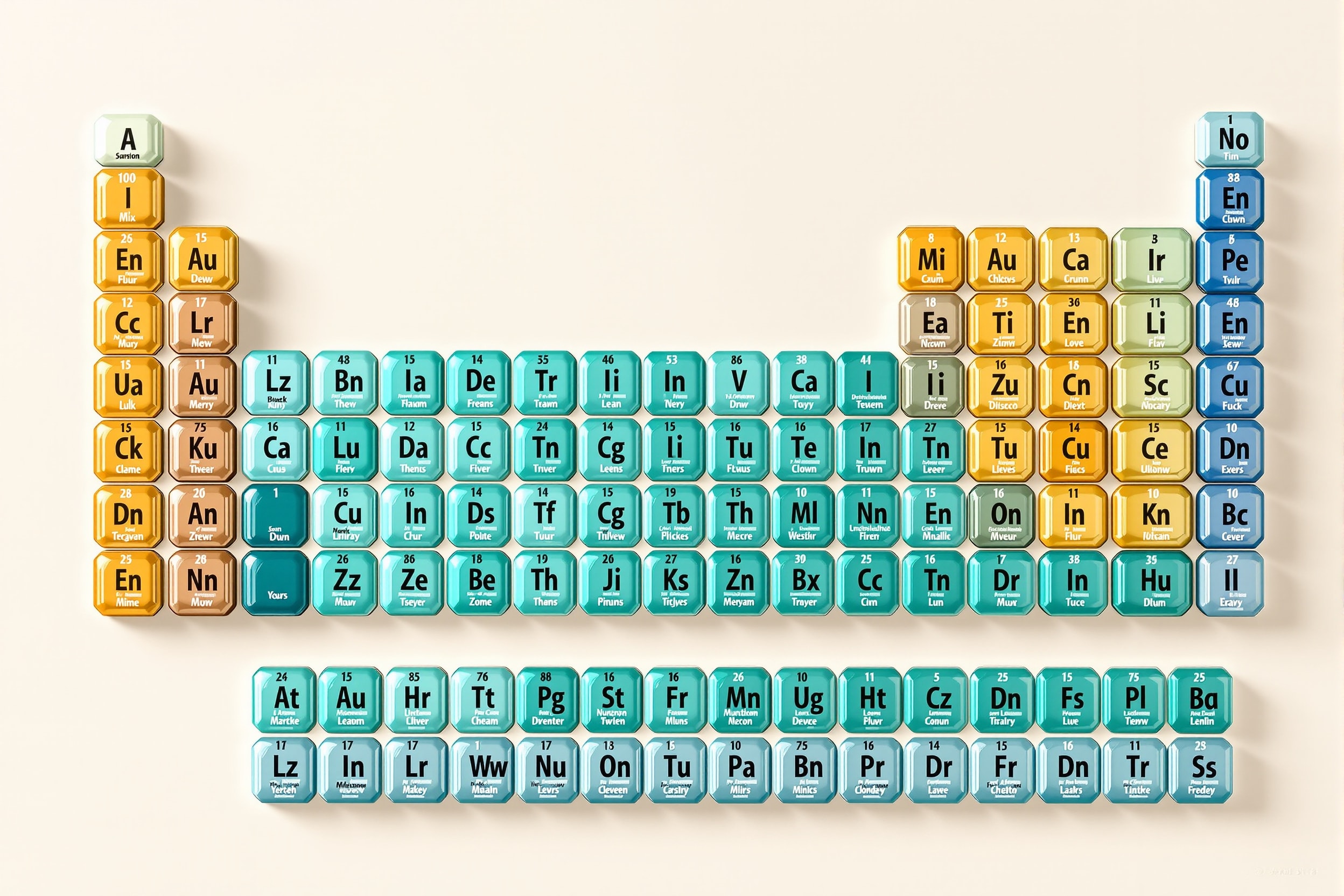
The periodic table is the most compact reference in all of science. On a single sheet it arranges every known chemical element so that an element's position tells you a great deal about how it behaves. Learning to read that position — rather than memorising a hundred separate facts — is the difference between finding chemistry bewildering and finding it orderly.
Mendeleev's Insight
When Dmitri Mendeleev laid out the elements by increasing atomic weight in 1869, he noticed that chemical properties repeated at regular intervals. His boldest move was to leave gaps where the pattern demanded an element that had not yet been discovered, and to predict the properties of those missing elements. When gallium and germanium were later found and matched his predictions, the table earned its authority. Today the elements are ordered by atomic number — the count of protons in the nucleus — which removed the few anomalies that atomic weight had left behind.
Periods and Groups
The horizontal rows are called periods; the vertical columns are groups. Moving across a period, each element gains one proton and one electron, and the added electrons fill the same outer shell. Moving down a group, elements share the same number of outer-shell (valence) electrons, which is why members of a group behave so similarly — the reactive alkali metals of group 1, the inert noble gases of group 18. The IUPAC numbering of the groups is the modern standard.
The s, p, d, and f Blocks
The table is also divided into blocks that name which type of orbital is being filled. The two left-hand columns are the s-block; the six right-hand columns are the p-block; the transition metals in the middle are the d-block; and the two rows floated below — the lanthanides and actinides — are the f-block. This structure is not decorative: it comes directly from the quantum mechanics of the atom, which our atomic physics page describes.
Periodic Trends
Because structure repeats, so do properties, and the regularities are called periodic trends. Three are worth committing to memory:
- Atomic radius generally decreases across a period (the growing nuclear charge pulls electrons in) and increases down a group (new shells are added).
- Ionisation energy — the energy needed to remove an electron — rises across a period and falls down a group, mirroring atomic radius.
- Electronegativity — an atom's pull on shared electrons — peaks near the top right (fluorine) and is lowest at the bottom left.
Once you can predict these three, a great deal of descriptive chemistry becomes something you can reason out rather than look up. The Royal Society of Chemistry's interactive table is an excellent place to explore the data behind each trend.
Humour as a Teaching Device
Chemistry teachers have long known that a good joke can smuggle in a real idea. The classic classroom quip — one sodium atom says “I think I've lost an electron,” and the other asks, “Are you positive?” — is funny only if you already understand that losing an electron leaves a positively charged ion. That is precisely why it works: the laugh confirms the concept. Illustrated periodic tables that dramatise the elements interacting are a venerable tradition in science education, and they earn their place by making an abstract grid memorable.
Why the Table Endures
New elements are still being added at the bottom of the table as they are synthesised, but its shape has not fundamentally changed in over a century. That durability is the mark of a genuinely deep idea: the periodic table is not a list we imposed on nature but a pattern we discovered in it.